
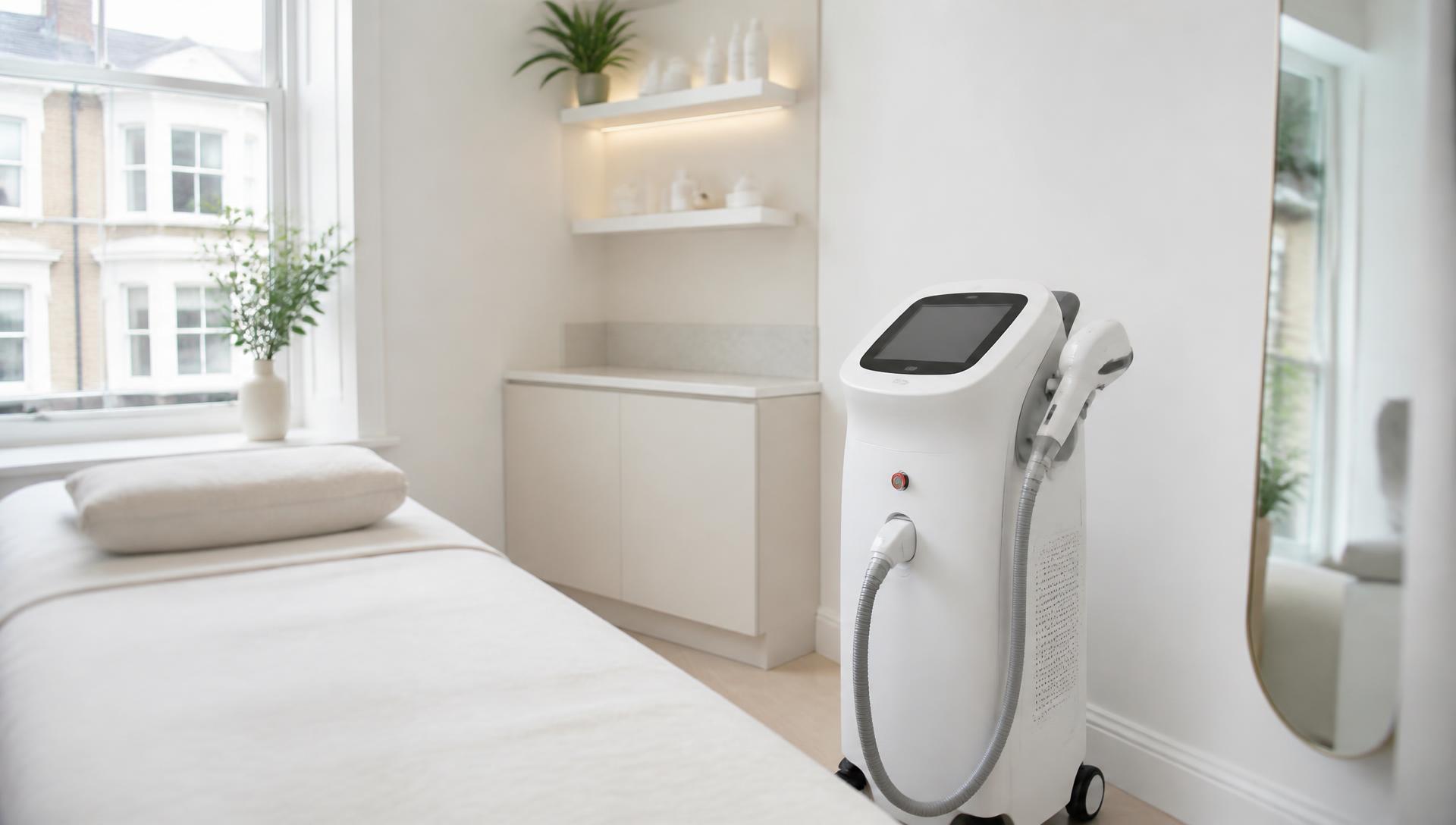
A first professional machine should be chosen from three numbers: the share of clients who are Fitzpatrick V–VI, realistic treatments per week within six months, and how much revenue comes from services other than hair removal. High skin-type reach and volume point to diode; a broad low-volume menu points to IPL or E-light.
- First-purchase checklist
- No brand bias
- Reviewed by our technical desk
- Typical first spend
- £4,800–£8,200
- Room size
- 2.5 x 3m minimum
- Training
- 2 days typical
Step one: who will you treat?
Look at your existing client list and your local catchment. If Fitzpatrick V–VI clients are part of the plan, you need 1064nm, and the entry price moves from £4,800 to £7,700. This decision cannot be deferred to a later upgrade without turning clients away in the meantime — and clients turned away rarely return.
Step two: what else will the machine sell?
Hair removal as a specialism points to diode. Hair removal as one line on a broad menu points to IPL or E-light, where pigmentation, vascular and rejuvenation modes come from the same console. A room doing eight treatments a week needs the breadth; a room doing thirty needs the throughput.
Step three: model the diary honestly
Use your own prices, not national averages, and your realistic weekly volume six months from now, not your ambition for year three. Divide the monthly finance payment by your average treatment price — if the machine needs fewer than about five treatments a month to cover finance, the maths is comfortable. The ROI calculator does this in a minute.
Step four: prepare the room
Check the electrical supply against the machine specification; a dedicated circuit may need an electrician. Confirm you can control access to the room during treatment and fit appropriate signage. Order wavelength-matched eyewear for operator and client. Write your local rules document.
Step five: compliance and insurance
Ask your local authority whether laser and IPL hair removal require a special treatment licence in your area, and whether it attaches to the premises or the practitioner. Ask your insurer what training and documentation they require before cover applies. Do both before you sign, because the answers occasionally change what is worth buying.
Step six: buy on support, not only on spec
For a single-machine business, downtime is total revenue loss. Ask about engineer response times, whether a loan unit is available during repair, parts lead times, and who holds the service records. A slightly better-supported machine at a slightly higher price is usually the cheaper one over three years.
Start with the client base, not the catalogue
Almost every regretted machine purchase in UK aesthetics starts the same way: the buyer chose the machine first and discovered the client base afterwards. The order is backwards. Your existing appointment book already tells you which technology you need, and it takes about an hour with a spreadsheet to find out. Pull the last three hundred clients, estimate the Fitzpatrick distribution from what you know of them, and count how many are types IV, V and VI. If that number is above a fifth of your book, a machine without genuine 1064nm Nd:YAG capability will make you turn away or under-treat a large and growing share of your enquiries.
The second question the book answers is area mix. A clinic whose demand is dominated by facial work, upper lip, chin and small detail areas needs small spot sizes, precise cooling and comfortable ergonomics for long, fiddly sessions. A clinic whose demand is full legs, backs and Brazilians needs the opposite: the largest spot size you can afford, a high repetition rate, and a handpiece light enough that an operator can hold it for thirty minutes without their shoulder giving out. Buying the wrong end of that spectrum is not a clinical failure, it is a throughput failure, and throughput is what pays for the machine.
| What your book shows | What that implies | What to insist on |
|---|---|---|
| Over 20% Fitzpatrick IV–VI | Diode alone is not enough for the darkest types | 1064nm Nd:YAG capability, contact cooling, conservative published protocols |
| Mostly large areas | Throughput decides your economics | Spot size 20mm+, 10Hz or better, lightweight handpiece |
| Mostly facial and detail work | Precision and comfort decide rebooking | Small spot options, fine fluence control, quiet operation |
| Mixed beauty and clinical | You need range without two machines | Dual-wavelength platform or a diode with a Nd:YAG module |
| Male clients above 30% | Coarse, dense, deep terminal hair | Higher peak fluence and strong cooling for tolerability |
| Strong course-based model | Consistency across sessions matters more than peak power | Repeatable settings, saved protocols, per-client parameter records |
The specification numbers that actually matter
Manufacturer datasheets are an exercise in choosing which numbers to print. Four specifications genuinely predict how a machine will behave in a UK treatment room, and the rest are marketing. Ask for these four, in writing, with the conditions under which they were measured.
The four numbers to compare
- 1
Spot size, in millimetres
The treatment window. Larger spots cover ground faster and penetrate slightly more effectively for the same fluence. Moving from 12mm to 20mm can cut a full-legs treatment by a third.
Look for 15–25mm on a large-area machine
- 2
Repetition rate, in hertz
Pulses per second in glide mode. Higher rates mean smoother, faster passes. Anything under 5Hz makes large-area work slow and tiring for the operator.
10Hz is a comfortable working baseline
- 3
Maximum fluence at the working spot size
The number most often quoted misleadingly. A machine may reach a high fluence only at its smallest spot and lowest repetition rate. Ask for fluence at 20mm and 10Hz, which is how you will actually use it.
Insist on the figure at working settings
- 4
Cooling method and sustained temperature
Contact sapphire cooling to a few degrees, sustained across a thirty-minute treatment, is what makes higher fluences tolerable. A machine that cools well for five minutes and then drifts warm will limit you clinically.
Ask what the tip temperature is at minute twenty-five
Demonstrations: how to run one properly
A demonstration organised by a salesperson is designed to flatter the machine. A demonstration organised by you is designed to answer your questions. The difference is preparation, and it costs you nothing but an hour of thinking beforehand.
- Bring your own models, ideally including a Fitzpatrick V and someone with fine, light hair. Both are the awkward cases where machines separate.
- Insist the demonstration happens on a full-size area, not a patch. Ask the operator to complete one full lower leg and time it with your own phone.
- Hold the handpiece yourself for five minutes. Weight, cable drag and balance decide whether your staff will still be treating well in the last appointment of the day.
- Ask to see the interface used to change parameters mid-treatment. Anything that requires three menus to lower fluence will be used badly under time pressure.
- Ask what happens when it breaks: who answers the phone, what the response time commitment is, and whether a loan unit is available.
- Ask for two UK clinic references using the same model at similar volume, and actually call them.
The reference calls are the highest-value hour in the whole process, and almost nobody makes them. Ask the referenced clinic three specific questions: how many treatments a week they run, how many days of downtime they have had in the last year, and whether they would buy the same machine again. The third question is answered honestly far more often than you would expect.
Regional differences across the UK
Regional differences across the UK
Where your room sits changes which specification is right. Skin-type mix, price tolerance and competitive density vary sharply across the UK, and each pushes the specification in a different direction.
England
Local authority environmental health, plus CQC where a doctor supervises
Deepest market and the most competition. Densest clinic clusters are London, Manchester, Birmingham, Leeds and Bristol.
Scotland
Healthcare Improvement Scotland
Concentrated in the central belt. Aberdeen and Dundee are under-served relative to population.
Wales
Healthcare Inspectorate Wales, plus local authority licensing
Cardiff, Swansea and Newport carry most demand; rural mid-Wales is thin.
Northern Ireland
RQIA
Belfast dominates; Derry and Newry are the next real markets.
| City | Nation | Market depth |
|---|---|---|
| London | England | Very high — hundreds of clinics, strong medical-grade positioning |
| Manchester | England | High — dense city-centre cluster plus suburban salons |
| Birmingham | England | High — large Fitzpatrick IV–VI client base favours Nd:YAG capability |
| Leeds | England | Moderate to high, student-driven volume pricing |
| Bristol | England | Moderate to high, strong independent clinic scene |
| Newcastle | England | Moderate — price-sensitive, package-led |
| Glasgow | Scotland | High — registration barrier keeps the low end thinner |
| Edinburgh | Scotland | Moderate to high, premium positioning holds |
| Cardiff | Wales | Moderate |
| Belfast | Northern Ireland | Moderate — aggressive course discounting |
Price bands are observed clinic list prices for a six-session large-area course (for example full legs or full back) and are indicative rather than a quotation. Licensing requirements change; confirm with the named body before you commission a machine.
In Birmingham, Leicester, east London and parts of Manchester, the Fitzpatrick IV–VI share of the market is high enough that Nd:YAG capability is close to a commercial necessity rather than a clinical nicety. In Edinburgh, Bristol and much of the south west, a well-specified 808nm diode covers the overwhelming majority of enquiries and the money is better spent on speed and cooling than on a second wavelength. In lower-priced markets like Belfast and the north east, throughput is the route to viability, which argues for the largest spot size and highest repetition rate within budget.
Competitive density matters too. In a saturated city centre you differentiate on outcome, comfort and skin-type coverage, so specification wins clients. In a thinly served suburban catchment, availability and price win clients, and a mid-tier machine used well beats a flagship used twice a week.
A first-machine shortlist that holds up
If you want a defensible default: a professional 808nm diode with a 20mm-plus spot, 10Hz, sustained contact cooling and a UK service contract, at somewhere between £7,700 and £9,800 ex. VAT, covers the widest share of UK first-machine buyers. Step up to a dual-wavelength platform if your book carries a real Fitzpatrick V–VI share. Step down to professional IPL only if your client base is genuinely Fitzpatrick I–III and your budget will not stretch, and go in knowing you will likely upgrade within three years.