
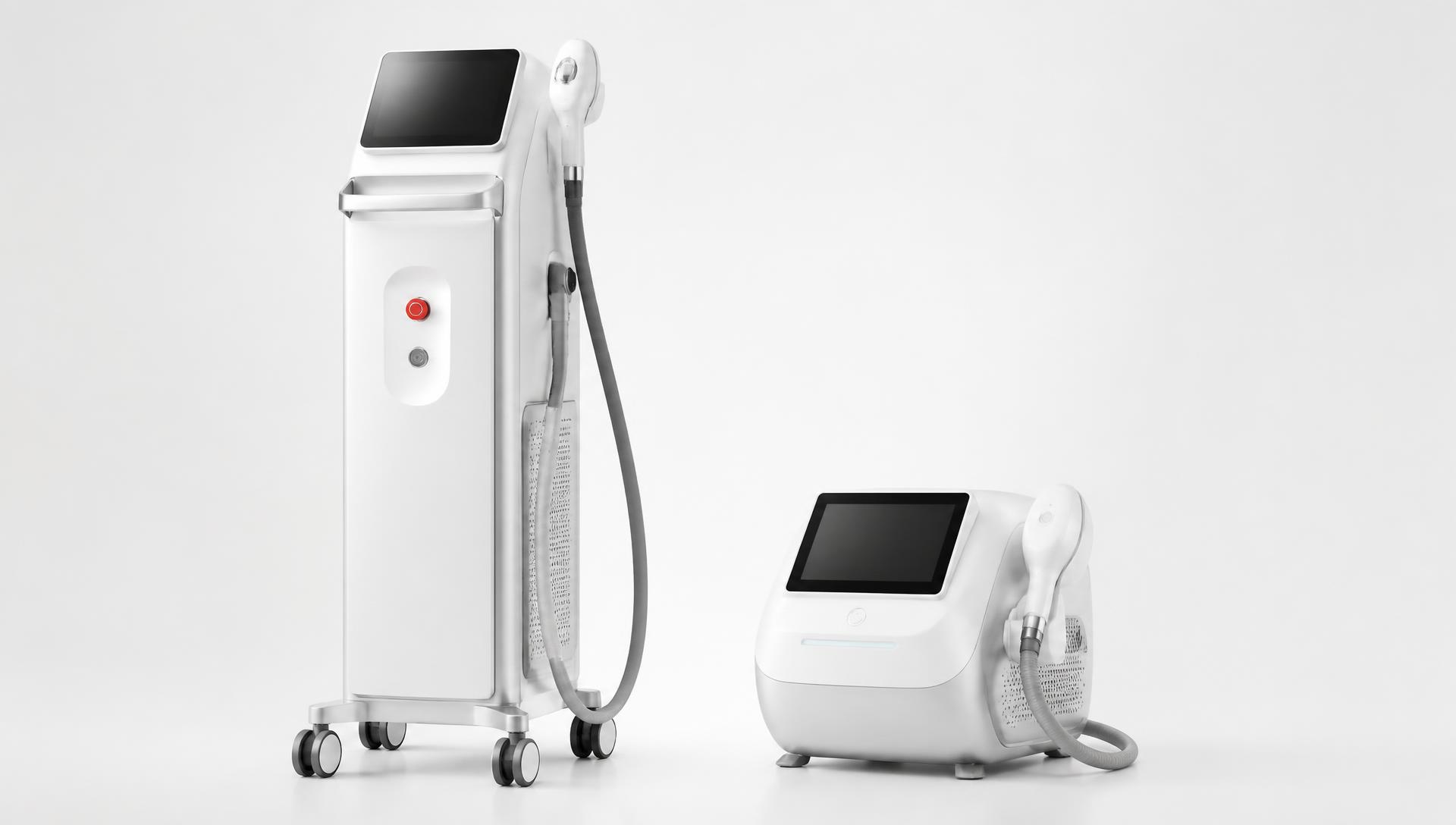
Melanin absorption falls and penetration depth rises as wavelength increases. 755nm suits fine light hair on Fitzpatrick I–III, 808nm is the everyday workhorse, 940nm adds depth on coarse follicles, and 1064nm is the standard wavelength for Fitzpatrick V–VI and recently tanned skin.
- Four wavelengths compared
- Fitzpatrick I–VI
- Operator-focused
- Wavelengths
- 755 / 808 / 940 / 1064nm
- Follicle depth
- 2–5mm
- Best all-rounder
- 808nm
The two curves that explain everything
Two properties change as wavelength rises. Melanin absorption falls, and penetration depth increases. Hair removal needs both: enough absorption to heat the follicle, and enough depth to reach the bulb, which sits two to five millimetres down depending on body area and hair type.
Every wavelength choice is a position on that trade-off. Short wavelengths heat efficiently but shallowly and cannot distinguish hair melanin from skin melanin. Long wavelengths reach deep and ignore skin melanin but need more energy to do the same work.
755nm
The strongest melanin absorption in clinical use. On Fitzpatrick I–III with fine, dark hair it reaches follicular damage temperature at a lower fluence than any other wavelength, which is both faster and more comfortable. Above Fitzpatrick III, that same absorption becomes a hazard: epidermal melanin competes with the target and the risk of burns and post-inflammatory hyperpigmentation rises sharply.
808nm
The default wavelength for professional diode systems, and for good reason. It penetrates deep enough for terminal hair on the body, absorbs strongly enough to work quickly, and competes less with epidermal melanin than 755nm, which widens the safe phototype range. If you only had one wavelength, this is the one to have.
940nm
Sits between the workhorse and the safe-on-dark-skin wavelength. Its value is depth on coarse follicles — beard, back, chest — on medium and darker skin, where 808nm starts to under-deliver at fluences the epidermis will tolerate. It is rarely a primary wavelength and almost always a useful third one.
1064nm
Weak melanin absorption, deep penetration. That combination makes it the standard wavelength for Fitzpatrick V–VI and the most tolerant option for recently tanned skin. The cost is fluence: the same follicular effect needs more energy, so treatments are slower and rely more heavily on cooling and pulse-width control for comfort.
Why quadruple-wavelength platforms exist
No single wavelength serves a mixed client base optimally. A platform emitting 755nm, 808nm, 940nm and 1064nm from one handpiece lets the operator bias towards absorption for fine light hair and towards depth and safety for dark skin, on consecutive clients, without changing applicator or machine. In a UK clinic with a mixed catchment, that flexibility usually shows up commercially as fewer declined consultations rather than as faster treatments.
How depth and absorption trade off
Every wavelength used in hair removal sits on a trade-off curve. Shorter wavelengths are absorbed more strongly by melanin, which makes them efficient at destroying pigmented hair but also makes them dangerous on pigmented skin, because epidermal melanin absorbs the energy first. Longer wavelengths are absorbed less strongly by melanin, which means they pass through the epidermis more safely and reach deeper, but they need more energy to do the same work on the follicle.
| Wavelength | Melanin absorption | Effective depth | Best for | Caution |
|---|---|---|---|---|
| 755nm alexandrite | Highest | Shallow to medium | Fine, light hair on Fitzpatrick I–III | Epidermal risk rises sharply from type IV |
| 808nm diode | High | Medium | The broad workhorse across types I–IV | Requires conservative protocols and good cooling at type IV |
| 1064nm Nd:YAG | Lowest | Deepest | Fitzpatrick V–VI and coarse, deep terminal hair | Needs higher fluence; tolerability depends on cooling |
This is why 808nm has become the default in professional practice. It sits at the point on the curve where melanin absorption is still high enough for efficient follicle damage, while depth is sufficient to reach terminal hair bulbs at two to four millimetres, and epidermal risk remains manageable on the great majority of UK client skin with adequate contact cooling.
Pulse duration: the specification nobody discusses
Wavelength decides where the energy goes. Pulse duration decides what happens once it arrives. The governing idea is thermal relaxation time: the period a heated structure takes to lose roughly half its heat to surrounding tissue. A fine hair cools quickly; a thick terminal hair holds heat far longer. Match the pulse to the target and you confine the damage to the follicle. Mismatch it and you either fail to heat the follicle sufficiently or you dump heat into the surrounding skin.
The curve is the whole argument in one picture. At 1064nm, melanin absorbs roughly a quarter of what it absorbs at 694nm, which is what creates the safety window for darker skin. The cost of that window is that you must deliver considerably more energy to achieve the same follicular damage, which in turn is why Nd:YAG platforms need substantial power supplies and serious cooling to be comfortable.
Dual-wavelength platforms and how they are actually used
A dual or triple-wavelength platform is not a machine that fires everything at once, whatever the marketing implies. In practice the operator selects a wavelength per client and often per body area, using 808nm as the default workhorse and switching to 1064nm for darker skin, for coarse male terminal hair, and for areas where hair sits deeper.
How an experienced operator chooses
- 1
Fitzpatrick assessment at consultation
Type recorded in the notes, with recent sun exposure and any tanning products noted, because both shift the effective type.
Never skipped, never assumed
- 2
Patch test at intended settings
Test patch at the settings you intend to use, then review after twenty-four to forty-eight hours before the first full treatment.
Required by most UK insurers
- 3
Wavelength selection
808nm for types I–IV in most cases. 1064nm for types V–VI, for coarse deep hair, and where a type IV client reacted strongly to a diode patch test.
Recorded per client per area
- 4
Fluence and pulse tuning across the course
Start conservative, step up as tolerance is proven session by session, and record every parameter so the next operator can reproduce it.
Consistency beats peak power
That last point deserves emphasis. Clients notice consistency, not peak specification. A course delivered at moderate settings by an operator who records and reproduces parameters produces better outcomes than one where every session is a fresh guess at higher power.
Regional differences across the UK
Regional differences across the UK
Wavelength requirements follow population, and UK populations differ sharply by city. The specification question is therefore local: the right wavelength mix for a clinic in Leicester is not the right mix for a clinic in Inverness.
England
Local authority environmental health, plus CQC where a doctor supervises
Deepest market and the most competition. Densest clinic clusters are London, Manchester, Birmingham, Leeds and Bristol.
Scotland
Healthcare Improvement Scotland
Concentrated in the central belt. Aberdeen and Dundee are under-served relative to population.
Wales
Healthcare Inspectorate Wales, plus local authority licensing
Cardiff, Swansea and Newport carry most demand; rural mid-Wales is thin.
Northern Ireland
RQIA
Belfast dominates; Derry and Newry are the next real markets.
| City | Nation | Market depth |
|---|---|---|
| London | England | Very high — hundreds of clinics, strong medical-grade positioning |
| Manchester | England | High — dense city-centre cluster plus suburban salons |
| Birmingham | England | High — large Fitzpatrick IV–VI client base favours Nd:YAG capability |
| Leeds | England | Moderate to high, student-driven volume pricing |
| Bristol | England | Moderate to high, strong independent clinic scene |
| Newcastle | England | Moderate — price-sensitive, package-led |
| Glasgow | Scotland | High — registration barrier keeps the low end thinner |
| Edinburgh | Scotland | Moderate to high, premium positioning holds |
| Cardiff | Wales | Moderate |
| Belfast | Northern Ireland | Moderate — aggressive course discounting |
Price bands are observed clinic list prices for a six-session large-area course (for example full legs or full back) and are indicative rather than a quotation. Licensing requirements change; confirm with the named body before you commission a machine.
In catchments where Fitzpatrick IV–VI clients form a substantial share of enquiries, 1064nm capability converts directly into revenue you would otherwise decline. In predominantly Fitzpatrick I–III catchments, a strong 808nm platform with excellent cooling and a large spot size will serve almost every client who walks in, and the money is better spent on speed than on a second wavelength you will use twice a month.
Wavelength myths worth retiring
- "Longer wavelength means more powerful." It means deeper and less melanin-absorbed, which is a different property entirely and usually requires more energy, not less.
- "Alexandrite is the gold standard." It is excellent on fine light hair on light skin and a poor choice on darker skin. There is no single gold standard across all Fitzpatrick types.
- "Triple wavelength fires all three simultaneously for better results." Most platforms let you select or blend; the clinical practice is selection per client, and blending is a convenience rather than a breakthrough.
- "Higher fluence is always better." Fluence beyond what the follicle needs simply raises epidermal risk. Correct fluence is the lowest that reliably achieves the clinical endpoint.