
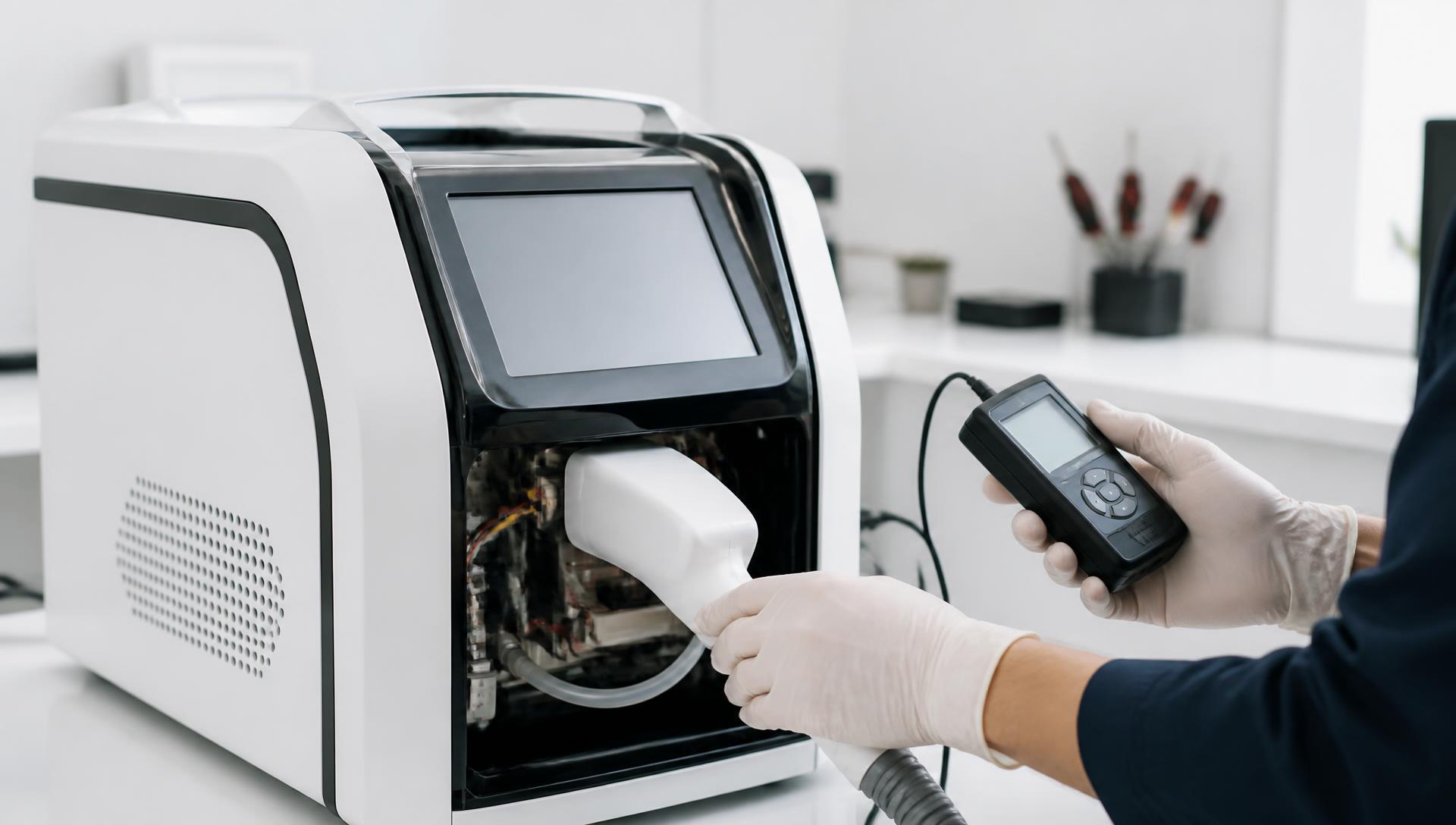
A refurbished professional machine is worth buying when it comes with a documented service history, a measured output calibration report, a written warranty and UK-based parts support. Without an output measurement, a refurbished laser is unverifiable: shot counters and cosmetic condition say nothing about delivered fluence.
- Calibration evidence first
- UK parts support
- Warranty guidance
- Typical saving
- 20–40%
- Must-have
- Output calibration report
- Warranty
- 12 months minimum
Shot count
Every professional platform logs shots. On a diode system that figure is the remaining-life indicator; on IPL it tells you how close the lamp is to replacement. A seller who cannot produce a shot count either cannot access the console logs or does not want to — neither is a good sign, and both make the machine unpriceable.
Service history and calibration
A service history shows whether faults recurred and whether they were fixed by an engineer or ignored. A calibration certificate under twelve months old proves that delivered fluence matches the console reading. Without calibration you have a clinical risk and, in practice, an insurance problem.
Who honours the warranty
A warranty is only as good as the entity behind it. A machine bought from a closing salon carries none once the company dissolves. Ask which UK entity backs the warranty, what it covers, and whether they hold parts for this model.
The grey-import trap
Units imported outside official distribution frequently cannot be serviced in the UK, because parts and firmware are not released to independent engineers. The machine may work perfectly on delivery and be a write-off at its first fault. Ask specifically who serviced it last and get the engineer's company name.
Ex-demo: the better middle route
Ex-demonstration units carry a few thousand shots against a rated life in the tens of millions, have never run a commercial diary, and are supplied with full warranty, commissioning and training. Availability is opportunistic rather than orderable, but on risk-adjusted value ex-demo generally beats refurbished.
What we will and will not sell
We only sell used machines we have commissioned or serviced ourselves, with shot count and calibration documented, a UK warranty, and entry onto our service records. That limits our used stock, which is the honest trade-off. Most of it arrives through part-exchange.
What refurbished actually means in this market
Refurbished is not a protected term. In UK aesthetics it covers everything from a two-year-old ex-demo platform with a full service history and a fresh calibration certificate, to a decade-old machine that has been wiped down, had its casing polished and been listed on a marketplace by someone closing a salon. The price difference between those two things is often smaller than you would expect, which is precisely why the category catches people out.
| Tier | Typical discount | What you should get |
|---|---|---|
| Ex-demonstration | 10 – 20% | Under twelve months old, low shot count, full manufacturer warranty, current software |
| Supplier-refurbished | 25 – 40% | Serviced, calibrated, tested to specification, warranty of six to twelve months, documented shot count |
| Trade-in resale | 40 – 55% | Working order, some service history, limited or third-party warranty, shot count may be partial |
| Private or auction sale | 50 – 75% | No warranty, no history, no support. Price the cost of a full service and a bar replacement into your offer |
The discount that looks best is almost always the tier with the least documentation, and that is not a coincidence. On a laser platform, the two things that carry most of the residual value — remaining bar life and a proven service record — are invisible in a photograph. A machine at fifty-five per cent off with eighteen million shots on an eighteen-million-shot bar is not a bargain; it is a chassis with a repair bill attached.
The pre-purchase inspection list
Ask for all of the following in writing before money moves. A legitimate seller produces them in a day. Anyone who cannot produce the shot count is either hiding it or does not know how to read it, and both are reasons to walk.
- Total shot count from the machine's own counter, photographed on the screen with the serial number visible.
- Rated shot life of the installed bar or lamp, and the current fitted replacement cost from the manufacturer or UK distributor.
- Full service history with dates, engineer names and the work carried out.
- The most recent calibration certificate, ideally under twelve months old.
- Confirmation that the manufacturer still supports the model in the UK and that spare parts remain available.
- Software version, and whether updates remain available to a second owner.
- Any incident history, including handpiece replacements and cooling system repairs.
- Evidence the machine is CE or UKCA marked with the original technical documentation available.
- A live demonstration on the seller's site, treating a test area, with output verified rather than described.
The economics: when used wins and when it loses
Used equipment wins in three situations. First, a second machine for an already-busy clinic that needs capacity rather than a flagship. Second, a specific capability you need occasionally, such as a Nd:YAG platform for a minority of your client base. Third, a genuine ex-demonstration unit with full warranty where you are simply capturing the depreciation of the first six months.
Used equipment loses when it is your only machine and your entire service depends on it. A new platform with a five-year support relationship is not just hardware; it is a phone number that answers when a handpiece fails on a Friday. The clinics that regret buying used are almost never the ones who bought a bad machine — they are the ones who bought a fine machine with nobody to call.
Full cover, one-day response
Twelve-month warranty then out of cover
One bar replacement and three weeks of downtime assumed
Over three years the totals land close enough together that the decision stops being financial and starts being about risk tolerance and cash. The private sale is cheapest to buy and, on these assumptions, the most expensive to own once downtime is priced properly. Supplier-refurbished sits in a genuinely sensible middle, which is why it is the tier we recommend to most second-machine buyers.
Regional differences across the UK
Regional differences across the UK
Used machines carry a compliance question that new ones do not: your licensing body will want the paperwork for the machine you actually own, and a second-hand purchase often arrives without it. Requirements differ meaningfully by nation, so check before you buy rather than after.
England
Local authority environmental health, plus CQC where a doctor supervises
Class 3B and Class 4 laser use is licensed by the local council under special treatment provisions in some areas and unregulated in others, so two salons twenty miles apart can face different paperwork. London boroughs are the strictest.
Scotland
Healthcare Improvement Scotland
Independent clinics using Class 3B or Class 4 lasers for hair removal generally require HIS registration, with a named responsible person, laser protection adviser input and written protocols inspected on site.
Wales
Healthcare Inspectorate Wales, plus local authority licensing
Local authority special treatment licensing applies in most areas, and HIW involvement follows if a regulated activity is provided. Expect a premises inspection and evidence of operator training.
Northern Ireland
RQIA
RQIA registration is required for establishments using Class 3B or Class 4 lasers and IPL for treatments, and the regime is applied consistently province-wide rather than council by council.
| City | Licensing body | Competition |
|---|---|---|
| London | Borough council special treatment licence | Very high — hundreds of clinics, strong medical-grade positioning |
| Manchester | Manchester City Council environmental health | High — dense city-centre cluster plus suburban salons |
| Birmingham | Birmingham City Council environmental health | High — large Fitzpatrick IV–VI client base favours Nd:YAG capability |
| Leeds | Leeds City Council environmental health | Moderate to high, student-driven volume pricing |
| Bristol | Bristol City Council environmental health | Moderate to high, strong independent clinic scene |
| Newcastle | Newcastle City Council environmental health | Moderate — price-sensitive, package-led |
| Glasgow | Healthcare Improvement Scotland registration | High — registration barrier keeps the low end thinner |
| Edinburgh | Healthcare Improvement Scotland registration | Moderate to high, premium positioning holds |
| Cardiff | Cardiff Council special treatment licence | Moderate |
| Belfast | RQIA registration | Moderate — aggressive course discounting |
Price bands are observed clinic list prices for a six-session large-area course (for example full legs or full back) and are indicative rather than a quotation. Licensing requirements change; confirm with the named body before you commission a machine.
In Scotland and Northern Ireland, where registration is handled centrally by HIS and RQIA, expect the technical file, calibration certificate and a laser protection adviser assessment to be requested as part of registration. Buying a machine with no documentation can therefore delay your ability to trade at all, not just your insurance. In England and Wales, where local authorities lead, the standard varies by council but the direction of travel is towards more documentation rather than less.
Practical rule: if the machine has no technical file and no calibration record, budget both a full engineer service and a fresh laser protection adviser report before you treat a single client, and price those into the offer you make.
Part exchange as the middle route
The option most buyers overlook is trading their existing machine against a new one. An ageing IPL system that struggles with darker skin types still has real value to a clinic serving a Fitzpatrick I–III client base, and moving it on through a supplier rather than a marketplace transfers the warranty and support question to someone equipped to answer it.