
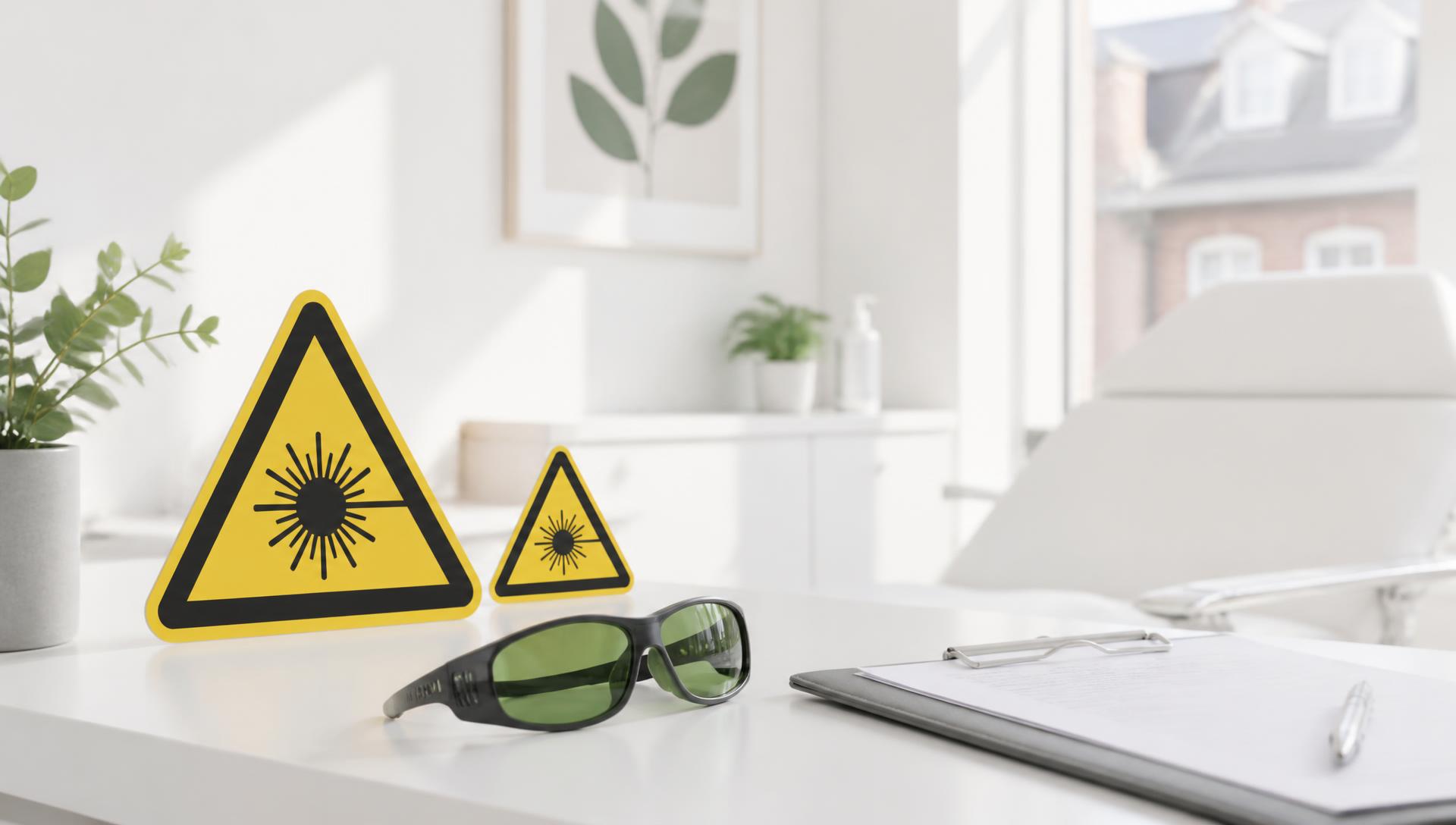
1064nm Nd:YAG has the lowest melanin absorption of the clinical hair removal wavelengths, so energy passes a pigmented epidermis and reaches the follicle. Safe treatment on Fitzpatrick V–VI needs long pulse widths, conservative fluence stepped up between sessions, sustained contact cooling and a patch test at least 24 hours ahead.
- Fitzpatrick V–VI protocol
- Patch test guidance
- Reviewed by our technical desk
- Wavelength
- 1064nm
- Cooling
- 0°C or below
- Patch test
- 24 hours minimum
The physics in one paragraph
Light-based hair removal works by selective photothermolysis: melanin absorbs light, converts it to heat, and the heat destroys the follicle. On darker skin the epidermis is also full of melanin, so it competes for the same energy. Raising wavelength lowers melanin absorption, which reduces that competition. At 1064nm it is low enough that energy reaches the follicle while the epidermis stays within a survivable temperature — provided fluence, pulse width and cooling are set correctly.
Pulse width
Thermal relaxation time — how quickly a structure sheds heat — scales with size. The epidermis is thin and cools quickly; a follicle is larger and holds heat longer. Long pulse widths exploit that difference: energy delivered slowly lets the epidermis dump heat continuously while the follicle accumulates it. On Fitzpatrick V–VI, use the longest pulse width that still achieves clinical effect.
Fluence discipline
Start below your expected working fluence. Treat, then read the response at the next appointment — perifollicular oedema and erythema that settles within hours is the target; blistering, prolonged erythema or pigment change is a signal to step back. Increase between sessions, never within a single visit, because reactions on darker skin can develop over hours.
Cooling
Sustained contact cooling is doing real clinical work here, not improving comfort scores. Sapphire contact cooling at or below 0°C removes heat from the epidermis during and immediately after each pulse. When assessing a machine for darker phototypes, test cooling across a long in-motion pass rather than a few shots — a system that warms after 90 seconds will force the operator to slow down or, worse, keep going.
Consultation and documentation
Record Fitzpatrick type, recent and planned sun exposure, self-tan use, medication and any history of keloid scarring or post-inflammatory hyperpigmentation. Patch test at intended settings at least 24 hours ahead, and re-test when phototype shifts seasonally. Photograph before the first session. This record protects the client clinically and protects you commercially.
Setting expectations
Because 1064nm works at lower absorption, courses often run a little longer than an equivalent Fitzpatrick II client at 755nm. Say so at consultation. Clients accept a realistic course length far more readily than they accept a revised one at session four.
Why Nd:YAG exists in a hair removal room
Nd:YAG at 1064nm is not a premium version of a diode. It is a different tool that solves a specific problem: how to destroy a follicle in skin that is itself full of the chromophore you are targeting. In Fitzpatrick V and VI skin, epidermal melanin competes for every photon. Shorter wavelengths lose that competition, depositing energy in the epidermis where it causes burns and post-inflammatory hyperpigmentation. At 1064nm, melanin absorption is low enough that a usable proportion of the energy reaches the follicle intact.
The same property makes Nd:YAG the sensible choice for deep, coarse terminal hair regardless of skin type — male backs and chests, dense beard-area work, and the stubborn cases where a diode course has stalled after five sessions. Depth is the other half of what a longer wavelength buys you.
1064nm
Wavelength
Lowest melanin absorption of the clinical range
V–VI
Fitzpatrick types served
Where diode and IPL are not appropriate
6–8
Typical sessions
Comparable to diode when correctly specified
4–5mm
Effective depth
Reaches deep terminal follicles
Protocol discipline: the part that cannot be shortcut
Nd:YAG is safe on darker skin because of how it is used, not merely because of the wavelength. Higher fluences are required, which means the margin for operator error is narrower in absolute terms even as the wavelength widens it. Every credible UK protocol for Fitzpatrick V–VI rests on the same four pillars, and skipping any of them is where incidents come from.
The four pillars of safe Nd:YAG practice
- 1
Accurate Fitzpatrick typing, recorded
Assess and record the type at consultation, note recent sun exposure and any self-tanning, and re-check at each session. A type V who has been on holiday behaves differently from the same client in February.
Recorded in the client notes every time
- 2
Patch test and a genuine wait
Patch test at intended settings and review at twenty-four to forty-eight hours. A patch test read after ten minutes tells you almost nothing about delayed reactions.
Insurers routinely require this
- 3
Sustained contact cooling
Cooling is what makes the required fluence tolerable and protects the epidermis. Verify that the tip holds temperature through a full thirty-minute treatment, not just the first five minutes.
Test this at demonstration
- 4
Conservative escalation
Begin below the target fluence and step up across sessions as tolerance is demonstrated, recording every parameter so any operator can reproduce the course exactly.
Consistency, not peak power
Comfort, and why clients say Nd:YAG hurts
Nd:YAG has a reputation for discomfort, and it is partly deserved and largely fixable. The fluences involved are genuinely higher, and heat deposited deeper produces a duller, more diffuse sensation than the sharp snap of a diode pulse. But the reputation was built on older platforms with weak cooling and short pulses. On a modern system with sapphire contact cooling, a long pulse and a competent operator working in glide mode, tolerability is close to diode for most clients.
- Use the longest pulse duration consistent with the clinical endpoint; it spreads the heat and reduces peak sensation.
- Keep the tip in firm contact and moving; lifting between pulses loses the cooling benefit entirely.
- Treat in multiple lower-fluence passes on sensitive areas rather than one aggressive pass.
- Manage expectations at consultation. Clients tolerate a sensation they were warned about far better than one that surprises them.
- Log a comfort score alongside settings so the next session starts from evidence rather than memory.
Indicative, from UK clinic feedback collected at course completion
Regional differences across the UK
Regional differences across the UK
Nd:YAG demand maps directly onto UK demographics. In several major cities it is the difference between serving your catchment and serving part of it, while in others it is a capability you will use occasionally and should buy accordingly.
England
Local authority environmental health, plus CQC where a doctor supervises
Deepest market and the most competition. Densest clinic clusters are London, Manchester, Birmingham, Leeds and Bristol.
Scotland
Healthcare Improvement Scotland
Concentrated in the central belt. Aberdeen and Dundee are under-served relative to population.
Wales
Healthcare Inspectorate Wales, plus local authority licensing
Cardiff, Swansea and Newport carry most demand; rural mid-Wales is thin.
Northern Ireland
RQIA
Belfast dominates; Derry and Newry are the next real markets.
| City | Nation | Market depth |
|---|---|---|
| London | England | Very high — hundreds of clinics, strong medical-grade positioning |
| Manchester | England | High — dense city-centre cluster plus suburban salons |
| Birmingham | England | High — large Fitzpatrick IV–VI client base favours Nd:YAG capability |
| Leeds | England | Moderate to high, student-driven volume pricing |
| Bristol | England | Moderate to high, strong independent clinic scene |
| Newcastle | England | Moderate — price-sensitive, package-led |
| Glasgow | Scotland | High — registration barrier keeps the low end thinner |
| Edinburgh | Scotland | Moderate to high, premium positioning holds |
| Cardiff | Wales | Moderate |
| Belfast | Northern Ireland | Moderate — aggressive course discounting |
Price bands are observed clinic list prices for a six-session large-area course (for example full legs or full back) and are indicative rather than a quotation. Licensing requirements change; confirm with the named body before you commission a machine.
Birmingham, Leicester, east and north London, Bradford, Luton and parts of Manchester and Glasgow all carry Fitzpatrick IV–VI populations large enough that a clinic without 1064nm capability declines a meaningful share of enquiries every week. In those markets the machine decision is straightforward: a dual-wavelength platform, or a diode plus a dedicated Nd:YAG, is the entry ticket.
Elsewhere, the honest assessment is that a strong 808nm diode covers the overwhelming majority of clients and Nd:YAG capability is a differentiator rather than a necessity. If you serve a smaller share of darker skin types, weigh the extra capital cost against the number of enquiries you currently turn away, and remember that word travels quickly in communities that are used to being told no.
Buying an Nd:YAG capability
Three routes exist. A dual-wavelength platform gives you 808nm and 1064nm in one chassis with one training pathway and one service contract, and is the default for most UK clinics adding the capability. A dedicated Nd:YAG makes sense at high volume of darker-skin work or where the machine also serves vascular treatments. A diode with an Nd:YAG module is the cheapest route in and is worth checking carefully: ask what fluence the module actually reaches at working spot size and repetition rate, because some modules are marketing rather than clinical capability.