
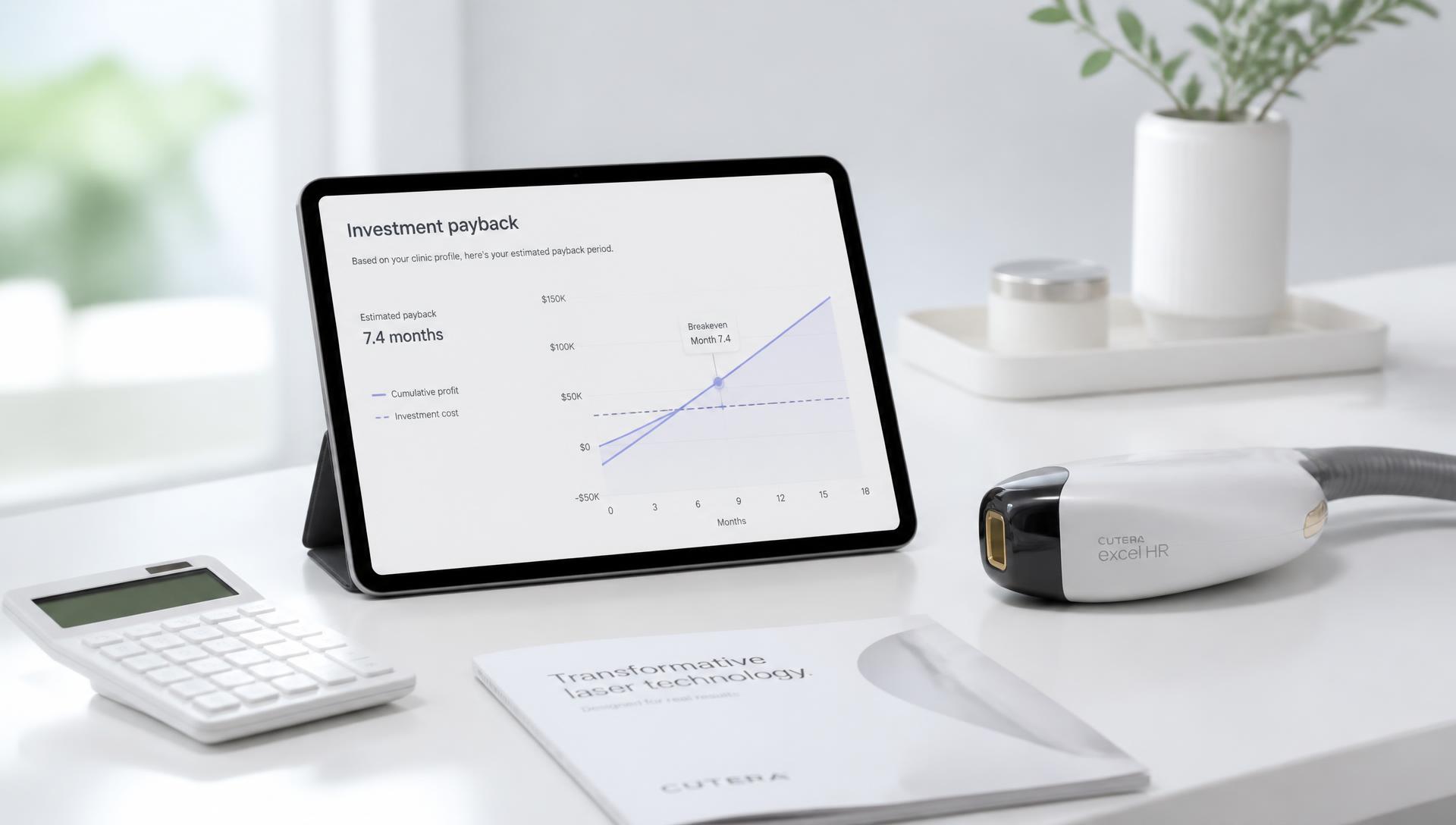
A professional hair removal machine in a UK clinic typically pays for itself in six to fourteen months. Payback is driven by four numbers: machine cost including install and training, average course price, courses sold per month, and fixed monthly cost of the room. Utilisation, not machine price, decides the outcome.
- Worked examples
- Finance compared
- Calculator linked
- Typical payback
- 6–14 months
- Break-even driver
- Room utilisation
- Finance term
- 36–60 months
The payback formula
Treat every input as a range rather than a point. Model a pessimistic case at half your expected bookings, a realistic case, and a strong case. If the pessimistic case still repays inside two years, the purchase is defensible to a lender and to yourself.
Most UK rooms overestimate bookings in month one and underestimate them in month six. Marketing lead time, not machine capability, is the usual constraint on early revenue.
Worked example: single-room salon
| Input | Pessimistic | Realistic | Strong |
|---|---|---|---|
| Total investment (machine, install, training) | £14,500 | £14,500 | £14,500 |
| Courses sold per month | 3 | 6 | 10 |
| Average course price | £450 | £550 | £650 |
| Monthly treatment revenue | £1,350 | £3,300 | £6,500 |
| Monthly running cost | £320 | £420 | £560 |
| Payback | ≈14 months | ≈5 months | ≈2.5 months |
The spread between columns is entirely bookings and pricing. The machine is identical in all three. That is why we specify on throughput and skin-type coverage rather than headline specification.
Where the revenue actually comes from
Highest value per chair hour
Fast, high-frequency rebooking
Often under-marketed
Large packages carry the business case. A machine with a big spot size and a fast repetition rate turns a two-hour full-body session into a manageable one, which is the difference between selling those packages and quietly avoiding them.
Cash, finance or lease
| Route | Upfront | Monthly | Notes |
|---|---|---|---|
| Cash | £15,000 + VAT | £0 | Lowest total cost, largest hit to working capital |
| Hire purchase | Deposit + VAT | £300–£450 | You own it at term end; interest is a cost of speed |
| Lease / rental | First payment | £280–£420 | Off-balance-sheet feel, may include servicing |
Five mistakes that wreck the model
- Forgetting VAT timing — you fund it before you reclaim it.
- Excluding install, training, eyewear, signage and insurance from the investment figure.
- Assuming month-one bookings match month-six bookings.
- Buying a machine that cannot safely treat Fitzpatrick V–VI in a mixed-population area, then losing a third of enquiries.
- Ignoring downtime risk on a single-machine room with no loan-unit cover.
Build your own numbers
Three payback numbers, not one
Suppliers quote gross payback because it is the flattering number. It divides the machine price by gross revenue and ignores everything else, which produces answers like six weeks that no clinic has ever actually experienced. Run three numbers instead and you will make a decision you do not have to revisit.
| Measure | Monthly figure | Payback on £12,260 setup |
|---|---|---|
| Gross revenue | £3,813 | 3.2 months |
| Less consumables (£95) | £3,718 | 3.3 months |
| Less operator time (£770) | £2,948 | 4.2 months |
| Less finance interest (£38) | £2,910 | 4.2 months |
| Less attributable marketing (£450) | £2,460 | 5.0 months |
The gap between 3.2 and 5.0 months is not a rounding error, it is the difference between a plan that survives contact with reality and one that does not. Note also what did not move the needle much: finance interest. The instinct to avoid finance in order to protect payback is usually misplaced. What moves payback is occupancy.
Sensitivity: what actually changes the answer
Run the same model with one variable moved at a time and the hierarchy becomes clear. Treatments per week dominates everything. Price per treatment matters roughly half as much. Machine price matters less than either, which is the opposite of how most buying decisions are made.
Two readings matter. First, every curve is steep on the left and flat on the right: the difference between four and eight treatments a week is transformative, while the difference between sixteen and twenty is marginal. Get the room to eight and you have a business. Second, the curves converge as volume rises, which means at high utilisation the more expensive, faster machine costs you very little in payback terms and buys you capacity, comfort and skin-type coverage. At low utilisation the cheap machine wins on paper and both machines lose in practice.
Course pricing and the cash timing problem
Hair removal is sold in courses, and courses create a cash timing distortion that wrecks naive payback models. If you take £780 up front for six sessions delivered over eight months, the cash arrives in month one and the cost arrives across months one to eight. Early payback looks spectacular and month seven looks terrible, because you are delivering treatments you were paid for last spring.
- Recognise course revenue across the sessions delivered, not on the day the card is taken. Your payback model and your accounts should agree.
- Hold a liability for undelivered sessions. If you sell forty courses and close, you owe forty clients a lot of treatments.
- Model month seven to twelve, not just month one to six. The second half of year one is where under-marketed rooms discover their problem.
- Watch course completion rate. Clients who stop at session four leave revenue on the table for you and a poor outcome for them, and drive refund requests.
8/wk
Treatments to break even
Fully loaded, including operator time
78%
Course completion rate
Below 65% suggests a consultation or results problem
£88
Realised session value
After package discounting, UK regional average
4–7
Months to contribution payback
Typical range for a filled single room
Regional differences across the UK
Regional differences across the UK
Payback is a function of local demand depth as much as local price. A city with high prices and heavy competition can be a slower payback than a mid-priced city with an under-served suburban catchment, because the constraint is filling the diary rather than the rate per session.
England
Local authority environmental health, plus CQC where a doctor supervises
Deepest market and the most competition. Densest clinic clusters are London, Manchester, Birmingham, Leeds and Bristol.
Scotland
Healthcare Improvement Scotland
Concentrated in the central belt. Aberdeen and Dundee are under-served relative to population.
Wales
Healthcare Inspectorate Wales, plus local authority licensing
Cardiff, Swansea and Newport carry most demand; rural mid-Wales is thin.
Northern Ireland
RQIA
Belfast dominates; Derry and Newry are the next real markets.
| City | Nation | Market depth |
|---|---|---|
| London | England | Very high — hundreds of clinics, strong medical-grade positioning |
| Manchester | England | High — dense city-centre cluster plus suburban salons |
| Birmingham | England | High — large Fitzpatrick IV–VI client base favours Nd:YAG capability |
| Leeds | England | Moderate to high, student-driven volume pricing |
| Bristol | England | Moderate to high, strong independent clinic scene |
| Newcastle | England | Moderate — price-sensitive, package-led |
| Glasgow | Scotland | High — registration barrier keeps the low end thinner |
| Edinburgh | Scotland | Moderate to high, premium positioning holds |
| Cardiff | Wales | Moderate |
| Belfast | Northern Ireland | Moderate — aggressive course discounting |
Price bands are observed clinic list prices for a six-session large-area course (for example full legs or full back) and are indicative rather than a quotation. Licensing requirements change; confirm with the named body before you commission a machine.
Two market shapes recur. Dense city-centre markets like central London, Manchester and Glasgow give you high prices and high customer acquisition cost, so the payback model is sensitive to marketing spend. Regional and suburban markets give you lower prices, cheaper acquisition and stronger word of mouth, so the payback model is sensitive to capacity and opening hours. Identify which shape you are in before you set the price list, because copying a London price into a thin market simply empties the diary.
One further regional factor: skin-type mix. In cities with large Fitzpatrick IV–VI populations — Birmingham, east and north London, Leicester, parts of Manchester — a machine without a credible 1064nm Nd:YAG capability will turn away a large share of enquiries. Those turned-away enquiries never appear in a payback model, which is why models built on machine price alone systematically over-reward the cheaper platform.
Building your own model in twenty minutes
The model, step by step
- 1
Total your setup cost
Machine, extra applicators, delivery and commissioning, room compliance, eyewear and signage, and training for two operators. Use the quotation, not the headline price.
Typically £11,000 – £16,000 for a first room
- 2
Set a realistic weekly volume
Start at your current comparable service volume, not at capacity. If you have never sold laser before, model four a week for the first quarter and eight from month four.
Be pessimistic here and nowhere else
- 3
Set realised, not list, session value
Take your intended course price, divide by sessions, and knock off ten to fifteen per cent for discounting and no-shows.
UK average lands near £88
- 4
Subtract consumables and loaded staff time
Roughly £5 per treatment in consumables and forty-five minutes of paid operator time per appointment slot.
This is the step most models skip
- 5
Divide and sanity check
Setup cost divided by monthly contribution gives contribution payback. If the answer is under three months, you have been too optimistic somewhere. If it is over eighteen, the volume assumption needs work before the machine choice does.
Cross-check against the ROI calculator