
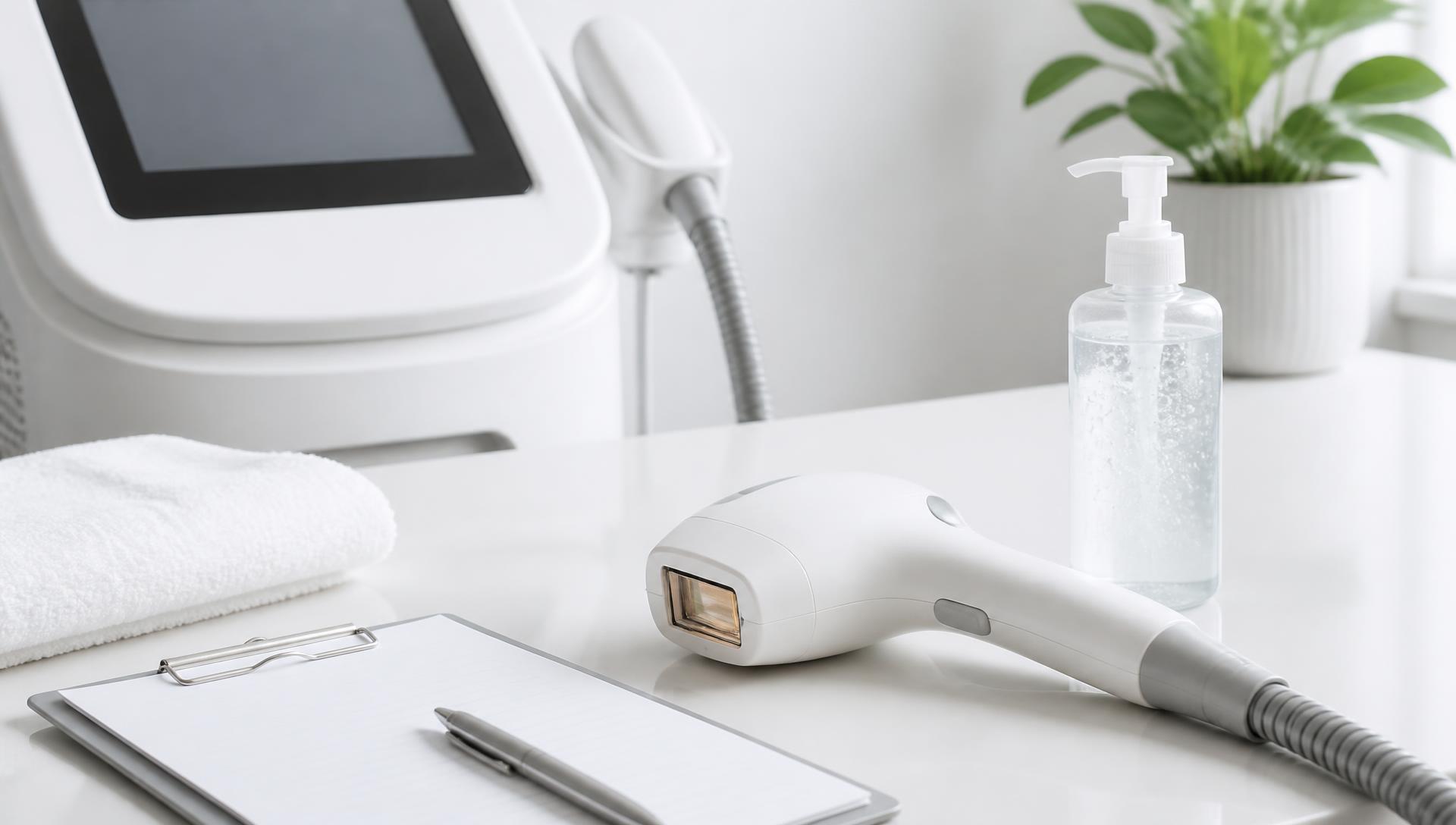
Diode running costs are servicing, calibration, gel, coolant and electricity, because diode bars are rated for 20–30 million shots and are not routinely replaced. IPL adds a consumable lamp cost per treatment. Over five years in a busy room, lamp replacement can close most of the price gap between IPL and diode.
- Five-year view
- Consumables costed
- Operator-focused
- Diode bar life
- 20–30m shots
- Service interval
- 12 months
- Main variable
- IPL lamp shots
Emitter life
On a diode platform the emitter is a solid-state bar rated in shots. At 200,000 shots a year, representative of a busy single-room clinic, a bar rated at 20 million shots outlives the platform's commercial life. Effective per-shot consumable cost is therefore zero.
On IPL, the lamp is consumable. Divide the replacement price by the rated shot count to get a per-shot figure, then multiply by your expected annual shots. In a busy room this is often the single largest recurring cost and it is the number most frequently absent from a quote.
Servicing and calibration
Budget an annual service with a calibration certificate. Insurers generally require current servicing for cover to respond, and a calibration certificate is what proves delivered output matches the console. Ask what the service costs after the first year, since year one is often bundled and year two is not.
Handpieces and parts
The handpiece is the part that gets dropped, kinked and worked hardest. On a diode system it is the largest out-of-warranty item, so ask for its replacement price before purchase — the answer tells you a great deal about a supplier's pricing philosophy. Also ask about parts lead times, because a cheap part on a four-week lead is an expensive outage.
Insurance, training and consumables
Treatment-risk insurance naming the machine renews annually. Training refreshers recur whenever staff change. Gel, coolant, wipes and disposable eyewear covers are small individually and add up predictably. Include them so your treatment pricing reflects reality.
What a single treatment actually consumes
Running cost analysis goes wrong when it is done per month instead of per treatment. Monthly figures hide the relationship between activity and cost, which is exactly the relationship you need when you are deciding whether to take on a discounted course or open on a Sunday. Cost it per treatment and the decisions become obvious.
| Item | Per treatment | Notes |
|---|---|---|
| Ultrasound or cooling gel | £0.60 – £1.40 | Large areas use 40–90ml; bulk 5L purchase halves the unit cost |
| Electricity | £0.35 – £0.90 | 1.5–3.2kW draw for 20–35 minutes at UK business unit rates |
| Couch roll and laundry | £0.45 – £0.85 | Higher if you launder gowns rather than use disposables |
| Aftercare product | £0.30 – £1.10 | Optional; some clinics build it into the course price |
| Diode bar amortisation | £0.40 – £1.60 | Replacement bar cost divided by rated shot life |
| Servicing amortisation | £0.70 – £1.90 | Annual contract divided by annual treatment volume |
| Total consumable cost | £2.80 – £7.75 | Against a typical realised session value of £70 – £190 |
At the midpoint, a large-area diode treatment consumes about £5 and bills between £70 and £190. That is a gross consumable margin above ninety per cent, which is why the entire economics of a laser room are dominated by two things that never appear on a consumables invoice: operator time and diary occupancy. An empty hour costs more than a hundred treatments' worth of gel.
IPL versus diode running cost, honestly
The lamp is the difference. An IPL handpiece lamp is a genuine consumable with a rated flash count, typically somewhere between fifty thousand and five hundred thousand flashes depending on the class of system, and a replacement typically costs between £180 and £900 fitted. A diode bar is also finite, but at twenty million shots it is a depreciation item rather than a monthly expense for most UK rooms.
Two lamp replacements plus gel and power
One lamp replacement across the year
Bar amortisation, gel, power
Higher power draw and two handpieces in rotation
£ per year, ex. VAT
The gap is real but it is not the deciding factor at 600 treatments a year; the difference between the best and worst case above is about £1,370, roughly eight extra treatments. The gap becomes decisive at high volume. At 1,800 treatments a year the same comparison spreads to well over £4,000, and at that point the diode has effectively repaid its higher purchase price on consumables alone.
Staff time is your largest running cost
Take a room running twelve large-area treatments a week. At thirty minutes of treatment plus fifteen minutes of consultation, patch testing, notes and turnaround, that is nine hours of paid operator time. At £16 an hour fully loaded, staff time is £144 a week, or £7,488 a year, against roughly £980 a year of consumables on a diode. Staff time is seven times the consumable bill and nobody ever asks about it on a first call.
In a typical UK single-room setup, operator time accounts for around seventy per cent of the true running cost of a laser hair removal service, and consumables under fifteen per cent.
Source: HairRemovalMachines.co.uk modelling from UK clinic operating data
This reframes the machine specification decision entirely. Buying a platform with a larger spot size and a higher repetition rate does not save gel; it saves the most expensive input you have. If a faster machine takes a full-legs treatment from thirty-five minutes to twenty, and you run twelve of those a week, you recover three hours of operator time a week — around £2,500 a year in a single room, before you count the extra clients that time can carry.
Regional differences across the UK
Regional differences across the UK
Running cost barely moves across the UK — gel and electricity cost much the same in Cardiff as in Camden — but the revenue those costs support moves a great deal. Running cost is therefore best judged as a percentage of realised session value in your own market rather than as an absolute number.
England
Local authority environmental health, plus CQC where a doctor supervises
Widest price spread in the UK. Central London list prices run roughly double a market town in the Midlands for the same six-session course.
Scotland
Healthcare Improvement Scotland
Mid-to-upper band. Glasgow and Edinburgh sustain course pricing close to regional English cities, with less discounting outside the central belt.
Wales
Healthcare Inspectorate Wales, plus local authority licensing
Slightly below the England average outside Cardiff. Cardiff itself prices close to Bristol.
Northern Ireland
RQIA
Lowest average course pricing of the four nations, with strong Belfast competition.
| City | 6-session course | Single session |
|---|---|---|
| London | £1,100 – £2,400 | £120 – £320 |
| Manchester | £700 – £1,500 | £75 – £190 |
| Birmingham | £650 – £1,400 | £70 – £175 |
| Leeds | £640 – £1,300 | £70 – £165 |
| Bristol | £700 – £1,450 | £75 – £180 |
| Newcastle | £560 – £1,200 | £60 – £150 |
| Glasgow | £680 – £1,400 | £70 – £175 |
| Edinburgh | £750 – £1,600 | £80 – £200 |
| Cardiff | £620 – £1,300 | £65 – £160 |
| Belfast | £550 – £1,150 | £55 – £140 |
Price bands are observed clinic list prices for a six-session large-area course (for example full legs or full back) and are indicative rather than a quotation. Licensing requirements change; confirm with the named body before you commission a machine.
In a £150 London session, £5 of consumables is three per cent. In a £60 Belfast session it is over eight per cent, and staff time as a share of session value roughly doubles. That is the practical reason clinics in lower-price markets tend towards faster machines, longer opening hours and package-led selling: the model has to win on throughput because it cannot win on price.
A twelve-month running cost budget you can copy
| Category | Annual, ex. VAT | How to control it |
|---|---|---|
| Gel and disposables | £620 | Buy 5L containers; switch to disposable couch covers only where laundry costs more |
| Electricity | £340 | Marginal. Do not compromise clinical settings to save it |
| Diode bar amortisation | £480 | Confirm rated shot life before purchase, not after |
| Annual service and calibration | £420 | Book it in a quiet trading week, not in January |
| Extended warranty | £780 | Compare against a single out-of-warranty repair quote |
| Insurance loading for laser | £240 – £700 | Declare the machine class accurately; non-disclosure voids cover |
| Operator time | £7,488 | The real number. Reduce it with machine speed and diary discipline, not shortcuts |
| Total | £10,368 – £10,828 | Against £42,000 – £60,000 of gross revenue at typical UK pricing |