
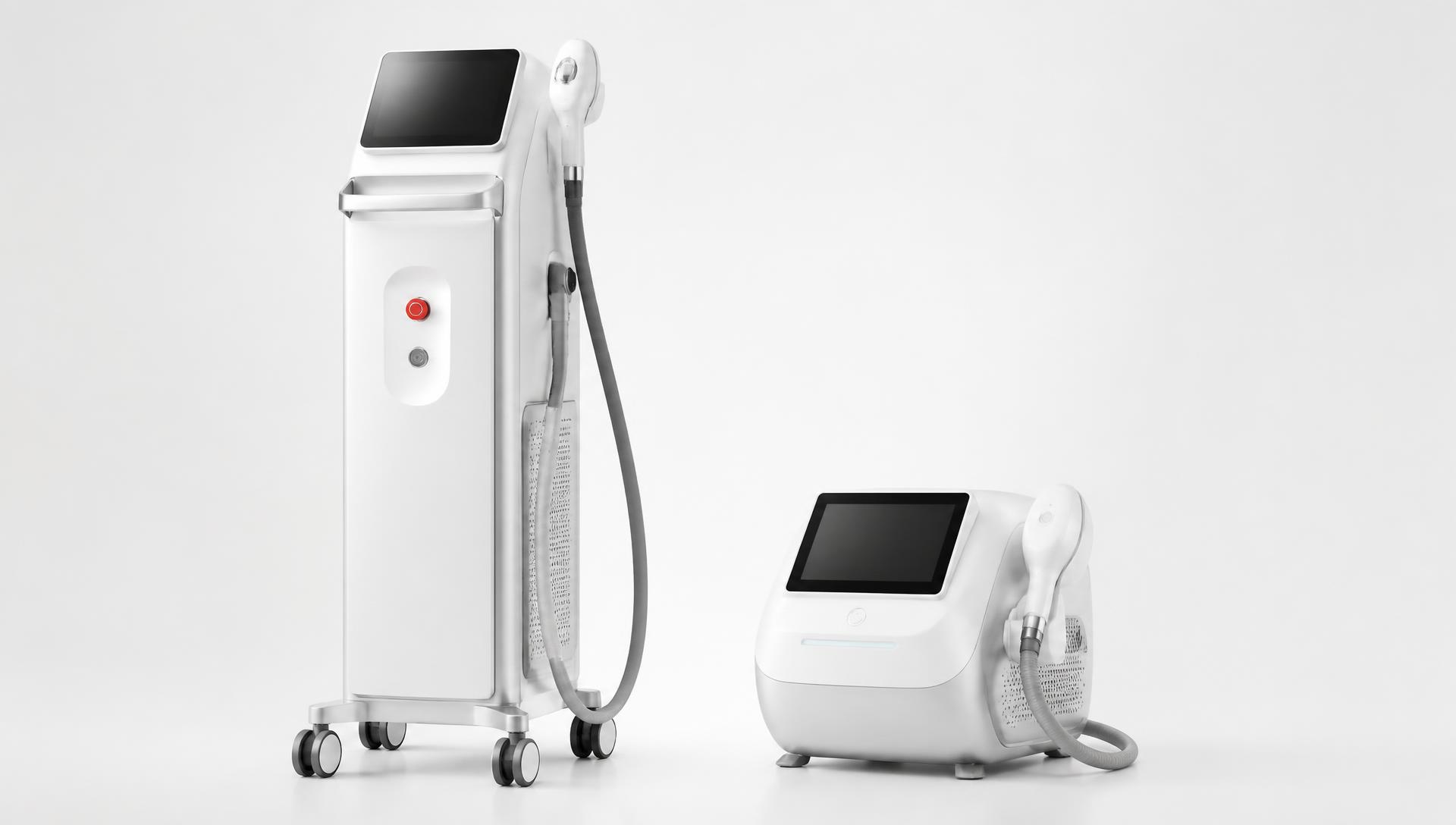
Laser emits one coherent wavelength; IPL emits filtered broadband light. For Fitzpatrick V–VI skin, 1064nm Nd:YAG laser is the clinical standard and IPL is not a substitute. Diode courses typically run six to eight sessions against eight to twelve for IPL, and diode has no consumable lamp.
- UK clinical practice
- No consumable-lamp bias
- Reviewed by our technical desk
- IPL from
- £4,800 ex. VAT
- Diode from
- £7,700 ex. VAT
- Course length
- 6–8 vs 8–12
What is physically different
A laser produces coherent light at a single wavelength. Every photon leaving the handpiece has the same energy, so its behaviour in tissue — how deep it goes, how strongly melanin absorbs it — is predictable and repeatable. That predictability is what allows tight protocols: a fluence and pulse width that worked last week will behave identically this week.
IPL produces a broad band of wavelengths from a flashlamp, cut at the low end by a filter. The output includes wavelengths the follicle needs and wavelengths it does not. The unneeded portion still deposits energy, mostly in the epidermis, which is the root of every practical limitation IPL has.
Skin-type reach: the decision that is not negotiable
On Fitzpatrick I–IV, both technologies work in trained hands. On Fitzpatrick V–VI, they diverge completely. Heavily pigmented epidermis absorbs broadband light strongly, so the safe window narrows until it effectively closes, whatever filter is fitted. The standard clinical answer for those phototypes is 1064nm Nd:YAG, whose low melanin absorption lets energy pass the epidermis and reach the follicle.
This is the single question that resolves most laser-versus-IPL decisions. Count the Fitzpatrick V and VI clients you expect to serve. If the number is meaningful, the technology choice is already made, and no amount of price advantage changes it.
Throughput and course length
A diode platform running a 20 x 20 mm sapphire-cooled spot in motion at up to 10 Hz clears a pair of full legs in roughly 20 minutes with a trained operator. IPL handpieces cover a comparable area per shot but generally run slower repetition rates and require more careful placement, which lengthens appointments.
Course length compounds the same effect. Six to eight diode sessions against eight to twelve IPL sessions changes the shape of your diary and the revenue per client, though it also means IPL clients buy longer courses — which some salons prefer commercially.
Running cost over five years
Diode bars are rated in shots, commonly 20 to 30 million, and are not routinely replaced within a platform's commercial life. Running cost is therefore annual servicing and calibration, gel, coolant and electricity.
IPL lamps are consumables. Ask for the rated shot count and replacement price before purchase and calculate a per-treatment consumable cost. Over five years in a busy room, that figure can close most of the gap between a £4,800 IPL and a £7,700 diode.
Where IPL is genuinely the better buy
A salon selling a broad menu at moderate volume to a mostly Fitzpatrick I–IV client base is better served by IPL or E-light. One console delivers hair reduction plus pigmentation, vascular and rejuvenation work, which is how a room doing eight to ten treatments a week reaches viable utilisation. Buying a specialist diode platform for that room means paying for throughput and skin-type reach you will not use.
How to decide in one sitting
Write down three numbers: the share of your clients who are Fitzpatrick V–VI, the hair removal treatments you realistically expect per week within six months, and the proportion of your revenue that will come from services other than hair removal. High on the first two points to diode. High on the third with low first two points to IPL. Anything ambiguous points to a quadruple-wavelength diode, which covers both futures.
Laser versus IPL compared on the numbers that decide a purchase
| Attribute | Diode laser | Professional IPL |
|---|---|---|
| Output | Single coherent wavelength | Filtered broadband, typically 640–950nm or 640–1200nm |
| Fitzpatrick V–VI | Yes, at 1064nm | Not clinically appropriate |
| Typical course | 6–8 sessions | 8–12 sessions |
| Full legs, trained operator | About 20 minutes | 30–45 minutes |
| Consumable emitter | None; bar rated 20–30m shots | Lamp, replaced on shot count |
| Entry price ex. VAT | £7,700 | £4,800 |
Longer at lower melanin absorption
Typical course length to satisfactory reduction
1064nm Nd:YAG is the standard wavelength for Fitzpatrick V–VI because melanin absorption is lowest there, letting energy pass a pigmented epidermis and reach the follicle.
The physics, stated plainly
Both technologies destroy hair follicles by selective photothermolysis: light is absorbed preferentially by melanin in the hair shaft, converted to heat, and that heat damages the follicle's regenerative structures. The mechanism is the same. What differs is the quality of the light delivered, and every practical difference between the two flows from that one fact.
A laser emits coherent, monochromatic light at a single wavelength — 755nm alexandrite, 808nm diode, 1064nm Nd:YAG. Every photon lands at the depth that wavelength reaches and is absorbed by the chromophore that wavelength targets. Intense pulsed light emits a broad spectrum, typically filtered to a band starting around 500 to 650nm and running out past 1200nm. Some of that spectrum does useful work on melanin in the follicle. Some is absorbed by haemoglobin and water, which produces heat where you did not want it, and some scatters in the epidermis, which is the part that causes trouble on darker skin.
| Dimension | Diode laser 808nm | Professional IPL |
|---|---|---|
| Light quality | Single coherent wavelength | Filtered broadband spectrum |
| Fitzpatrick I–III | Excellent | Good to excellent |
| Fitzpatrick IV | Very good with conservative protocols | Variable, operator-dependent |
| Fitzpatrick V–VI | Diode alone is not the standard; 1064nm Nd:YAG is | Not appropriate |
| Typical course length | 6 – 8 sessions | 8 – 12 sessions |
| Consumable | Gel only; bar is a long-life wear item | Lamp replacement at £180 – £900 fitted |
| Purchase price | £7,700 – £12,500 ex. VAT | £4,800 – £8,500 ex. VAT |
| Large-area speed | Faster at equivalent spot size | Slower; larger windows offset partly |
| Secondary uses | Hair removal focused | Vascular and pigmentation with the right filters |
The table hides one nuance worth stating: a well-specified professional IPL in the hands of a well-trained operator on Fitzpatrick II skin produces excellent results, and a poorly used diode does not. Technology sets the ceiling; training decides where inside that ceiling you actually operate.
Course length is the commercial argument
Buyers focus on capital price and miss the number that decides the P&L: how many sessions it takes to reach the result the client was promised. A six-session diode course and a ten-session IPL course sold at the same total price mean the IPL room delivers four extra appointments for the same money, consuming four extra hours of operator time, four extra slots of room capacity and four extra chances for a no-show.
Fastest route to a completed course
Coarser or hormonally driven hair
Best case on Fitzpatrick I–II
Common on Fitzpatrick III–IV or fine hair
Assumes 30 minutes treatment plus 15 minutes turnaround per session
Four and a half hours versus nine hours per completed client is a doubling of the largest cost in the business. At £16 an hour loaded, that is £72 of extra operator cost per client, and in a room completing eighty courses a year it is £5,760 — comfortably more than the capital price difference between the two technologies, every single year.
Skin type is where the argument stops being commercial
For Fitzpatrick V and VI skin, the safety margin between the energy needed to damage the follicle and the energy that damages the surrounding epidermis narrows sharply, because there is competing melanin everywhere. Broadband light makes this worse: the shorter wavelengths in an IPL spectrum are absorbed strongly by epidermal melanin and never reach the follicle usefully. The clinical answer in the UK is 1064nm Nd:YAG, where the longer wavelength is comparatively poorly absorbed by epidermal melanin and reaches the deeper follicle structures.
1 in 5
Enquiries typically Fitzpatrick IV+
Across UK urban clinic catchments
Higher
In Birmingham, Leicester, east London
Nd:YAG capability becomes a requirement
6–8
Sessions on Nd:YAG
Comparable to diode when correctly specified
0
IPL protocols for type VI
Not a treatment we would support
Regional differences across the UK
Regional differences across the UK
The laser-versus-IPL decision resolves differently in different UK markets, almost entirely because of local skin-type distribution and price tolerance rather than any difference in the physics.
England
Local authority environmental health, plus CQC where a doctor supervises
Deepest market and the most competition. Densest clinic clusters are London, Manchester, Birmingham, Leeds and Bristol.
Scotland
Healthcare Improvement Scotland
Concentrated in the central belt. Aberdeen and Dundee are under-served relative to population.
Wales
Healthcare Inspectorate Wales, plus local authority licensing
Cardiff, Swansea and Newport carry most demand; rural mid-Wales is thin.
Northern Ireland
RQIA
Belfast dominates; Derry and Newry are the next real markets.
| City | Nation | Market depth |
|---|---|---|
| London | England | Very high — hundreds of clinics, strong medical-grade positioning |
| Manchester | England | High — dense city-centre cluster plus suburban salons |
| Birmingham | England | High — large Fitzpatrick IV–VI client base favours Nd:YAG capability |
| Leeds | England | Moderate to high, student-driven volume pricing |
| Bristol | England | Moderate to high, strong independent clinic scene |
| Newcastle | England | Moderate — price-sensitive, package-led |
| Glasgow | Scotland | High — registration barrier keeps the low end thinner |
| Edinburgh | Scotland | Moderate to high, premium positioning holds |
| Cardiff | Wales | Moderate |
| Belfast | Northern Ireland | Moderate — aggressive course discounting |
Price bands are observed clinic list prices for a six-session large-area course (for example full legs or full back) and are indicative rather than a quotation. Licensing requirements change; confirm with the named body before you commission a machine.
Urban catchments with large South Asian, African and Caribbean populations make Nd:YAG capability a commercial requirement, not an upgrade path. Markets with predominantly Fitzpatrick I–III demand can build a genuinely good business on professional IPL, particularly where the offer sits alongside facials and skin treatments that use the same platform's vascular and pigmentation filters.
Price tolerance interacts with this. In a market where a six-session course sells at £1,400, the extra four IPL sessions are painful but survivable. In a market where the same course sells at £600, the extra operator hours consume the margin entirely, and diode becomes the only technology that works financially at that price point.
Where IPL is genuinely the right answer
- A beauty salon with a Fitzpatrick I–III client base adding hair removal alongside facials, where multi-application filters earn their keep across several services.
- A first machine on a constrained budget where the alternative is not buying at all, with a clear plan to move to diode within three years.
- A second machine in a busy clinic where the diode carries the large-area load and IPL absorbs overflow and lighter cases.
- A practitioner whose training and confidence are strongest on IPL, where the near-term outcome for clients is better on the technology the operator uses well.