
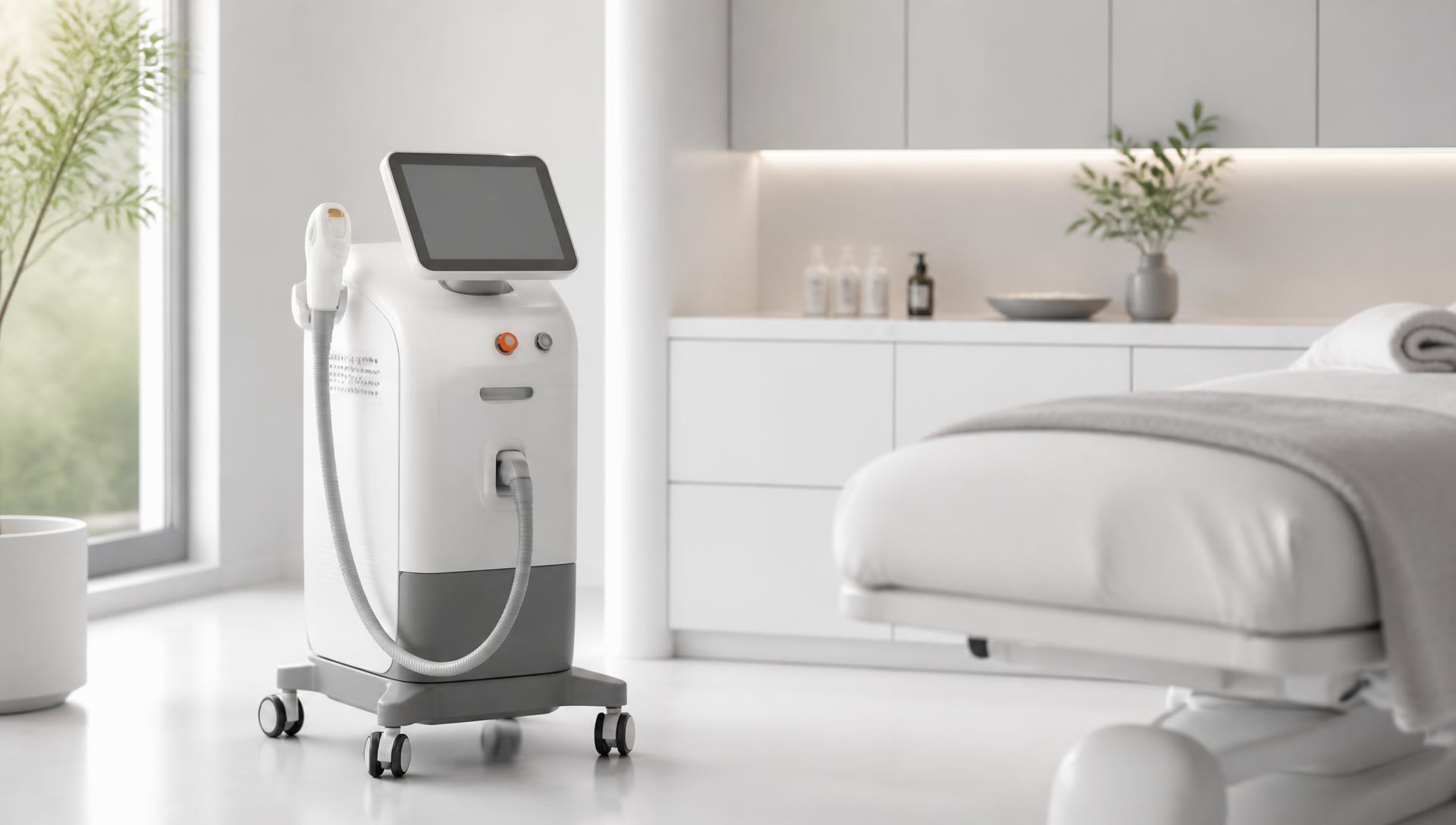
Professional hair removal machines sell in the UK for roughly £4,800 to £12,500 ex. VAT. IPL, SHR and E-light platforms occupy £4,800–£6,600, quadruple-wavelength diode systems with 1064nm run £7,700–£8,200, and multi-technology consoles reach £10,000–£12,500. Install, training and insurance add £1,000–£2,500 regardless of tier.
- Prices ex. VAT
- UK supply and install
- Updated for 2026
- Entry price
- £4,800 ex. VAT
- Diode platform
- £7,700 ex. VAT
- Setup extras
- £1,000–£2,500
The three price tiers
£4,800 to £6,600 buys a broadband platform — SHR IPL, E-light IPL with RF, or an IPL and Q-switched Nd:YAG desktop. Broad menu, modest throughput, Fitzpatrick I–IV in practice, consumable lamps.
£7,700 to £8,200 buys a quadruple-wavelength diode emitting 755nm, 808nm, 940nm and 1064nm with sapphire contact cooling. This is where Fitzpatrick V–VI becomes safely treatable and where per-shot consumable cost disappears.
£10,000 to £12,500 buys a multi-technology console — diode plus Nd:YAG plus E-light — with the cooling and duty cycle for back-to-back clinic days.
The £1,100 that matters most
The step from the top of the IPL range to the bottom of the diode range is the most consequential thousand pounds in this market, because it is where skin-type coverage changes. Over a 48-month lease that difference is a few tens of pounds a month. If it wins one extra client a month, it pays for itself immediately.
What is not in the machine price
A dedicated 13A or 16A circuit if your room lacks one. Operator training for every user. Wavelength-matched safety eyewear for operator and client. Room signage and controlled access. Insurance naming the machine. Annual servicing and calibration. Consumables — gel, coolant, and IPL lamps where applicable.
None of these scale with purchase price, so they weigh proportionally heavier on the cheapest machine. A £4,800 platform can carry the same £1,500 of first-year overhead as a £12,500 one.
A realistic five-year view
Take the capital cost, add first-year setup, then add annual servicing, insurance, consumables and any lamp replacements across five years. For a diode platform in a single busy room, the ongoing figure is dominated by servicing and insurance. For IPL, lamps can become the largest recurring line — which is why the rated shot count and replacement price belong in writing on the quote.
How to judge a quote
Ask for: the ex. VAT price, what commissioning and training include, warranty length and what it covers, the annual service cost after year one, the cost of a replacement handpiece, and the lead time as a date. A supplier who answers all six in writing is telling you what the machine really costs. One who answers only the first is quoting a headline.
UK price bands for a hair removal machine in 2026
| Tier | Technology | Price band ex. VAT | Skin types in practice | Consumables |
|---|---|---|---|---|
| Entry | SHR / E-light IPL | £4,800 – £6,600 | Fitzpatrick I–IV | Lamp, rated in shots |
| Core | Quadruple-wavelength diode | £7,700 – £8,200 | Fitzpatrick I–VI | None beyond gel and coolant |
| Platform | Diode + Q-switched Nd:YAG + IPL | £10,000 – £12,500 | Fitzpatrick I–VI plus pigment work | None beyond gel and coolant |
The tier you need is set by clinical reach and weekly volume, not by ambition. A room treating eight clients a week on Fitzpatrick I–IV skin will not recover the extra £3,000 that a diode platform costs; a room with a mixed catchment and twenty-five treatments a week will recover it inside a year in sessions it would otherwise have declined.
Includes three lamp replacements
No consumable emitter
Two handpiece services
Estimated five-year total cost of ownership, our modelling
What setup costs a hair removal machine adds beyond the invoice
- Electrical supply: a commercial diode typically needs a dedicated 13A or 16A circuit. Expect £250–£600 from a qualified electrician.
- Operator training: two days is typical for a first machine, £400–£900 per operator.
- Wavelength-rated eyewear for every person in the room, plus a spare pair for the client.
- Laser controlled-area signage and an interlock or door notice, per BS EN 60825 practice.
- Treatment-specific insurance and, in many local authority areas, a special treatment licence fee.
Which hair removal machines sit in each price band
The five cost layers, in the order you meet them
Buyers almost always compare machines on a single number: the ex-VAT purchase price on the quotation. That number decides less than half of what the machine will actually take out of the business over its working life. A professional diode platform bought at £8,200 and run at twelve treatments a week for five years will absorb somewhere between £6,000 and £14,000 more in commissioning, training, consumables, servicing, insurance and finance interest before it is retired or part-exchanged. The spread between those two figures is not luck. It is decided by choices you make in the first eight weeks of ownership, and almost all of them are visible at the quotation stage if you know what to look for.
It helps to break the total into five layers. Layer one is capital: the machine, delivery, and any handpiece or applicator you add at order. Layer two is commissioning: electrical checks, room modifications, signage, protective eyewear, a laser protection adviser report where your licensing body wants one. Layer three is competence: operator training, the Core of Knowledge day, device-specific training, and the shadowing hours before a new operator is safe on paying clients. Layer four is running cost: consumables, gel, cooling, electricity, laundry, and the treatment time you cannot bill for. Layer five is ownership: servicing contracts, calibration, insurance loading, and the interest you pay if you finance rather than buy outright.
One operator, eight to ten treatments a week
Two operators, twenty to twenty-four treatments a week
Three operators, thirty-plus treatments a week including skin types V–VI
Read that chart the way an accountant would. Capital is the largest single block but it is the block you control least once you have chosen a technology tier. The blocks you do control are training and running cost, and those two are also the blocks that decide clinical outcome. Underspending on training is the single most reliable way to convert a good machine into a bad investment, because undertrained operators treat conservatively, produce slow results, and generate the refund conversations that destroy a course-based business model.
What the quotation should itemise before you sign
A quotation that shows one line and one number is not a quotation, it is a price. Ask for the following to be separated out, in writing, before you commit. Every reputable UK supplier will do this without argument, and the ones who resist are usually hiding either a consumable dependency or a servicing model that only becomes expensive in year two.
| Line item | Typical range, ex. VAT | Why it matters |
|---|---|---|
| Machine and standard handpiece | £4,800 – £12,500 | The headline. Confirm which handpiece sizes are included, not just the count |
| Additional spot sizes or applicators | £450 – £1,900 each | Small spot sizes drive facial and detail work margin |
| Delivery, siting and commissioning | £150 – £600 | Should include a working handover on your own site, not a video call |
| Core of Knowledge training | £180 – £350 per person | Required by most UK licensing bodies before Class 3B/4 use |
| Device-specific training | £350 – £900 per person | Ask whether refresher training for new staff is charged again |
| First-year warranty | Usually included | Confirm whether it covers the diode bar or only the chassis |
| Extended warranty, years two to five | £450 – £1,400 per year | Compare against the quoted cost of a single out-of-warranty repair |
| Annual service and calibration | £280 – £650 per visit | Some licensing bodies want evidence of an annual calibration record |
| Consumables pack | £0 – £900 per year | Diode: gel and filters. IPL: lamp replacement is the big one |
VAT, capital allowances and how UK buyers actually pay
Every price on this site is quoted excluding VAT, because almost every buyer is a VAT-registered business or is about to become one. If you are VAT registered, the VAT on a machine purchase is normally recoverable in the quarter you buy, which materially changes cash flow: a £9,600 machine costs £11,520 out of the bank and returns £1,920 at the next return. If you are not VAT registered, that £1,920 is a real cost and should sit in your payback maths.
Capital allowances are the second lever. Professional treatment equipment normally qualifies as plant and machinery, which for most UK trading companies means the Annual Investment Allowance can be claimed against profits in the year of purchase rather than depreciated slowly. For a company paying corporation tax, that can shift the effective net cost of a £9,600 machine down by a meaningful fraction in the first year. This is genuinely a conversation for your accountant rather than your supplier, and the honest answer from us is that we will give you the invoice detail they need and no tax advice at all.
38%
Outright purchase
Mostly established clinics replacing an ageing platform
44%
Lease or hire purchase
Typically thirty-six to sixty months
12%
Part exchange plus balance
Older IPL traded against a diode upgrade
6%
Staged or deposit-led
New rooms opening with a phased fit-out
Finance is not automatically the expensive option. On a thirty-six month hire purchase at a typical UK business rate, the interest on a £9,600 machine adds roughly £900 to £1,500 across the term. If the machine bills £4,000 a month gross from month two, that interest is cheap money. Finance becomes expensive in exactly one scenario: when you finance a machine you cannot fill. The failure mode is never the rate, it is the diary.
A worked example, start to finish
Take a two-room salon in Leeds adding laser to an existing beauty offer. They choose a mid-tier diode platform at £8,900 ex. VAT with a second spot size at £650. Delivery and commissioning is £350. Two operators go through Core of Knowledge at £240 each and device training at £550 each, so competence costs £1,580. Eyewear, signage, a door interlock and a laser protection adviser report come to £780. Total to open the door: £12,260 ex. VAT.
They price a six-session large-area course at £780, which sits inside the Leeds band, and sell a single session at £95. In the first quarter they run ten treatments a week at an average realised value of £88 after package discounting, so £880 a week, £3,813 a month. Consumables and electricity run about £95 a month. Servicing is covered by the first-year warranty. Against £12,260 of setup, gross payback lands at roughly month four; the honest, all-in payback including staff time at £16 an hour for eleven billable hours a week is closer to month six.
The two lines cross between month four and month five. Everything after that point is contribution, and the shape of the revenue line is what matters most: it is a straight line only because the salon holds ten treatments a week. In practice the line bends upward once existing beauty clients convert, and it flattens hard in any month where an operator leaves and the second room goes quiet. That is why training two operators, not one, is a cost item with a return rather than an indulgence.
Regional differences across the UK
Regional differences across the UK
The same machine pays for itself at very different speeds depending on where the room is, because the achievable price per session moves more across the UK than the cost of the equipment does. A machine that needs eleven treatments a week to clear its costs in Belfast may need only six in central London at London list prices.
England
Local authority environmental health, plus CQC where a doctor supervises
Widest price spread in the UK. Central London list prices run roughly double a market town in the Midlands for the same six-session course.
Scotland
Healthcare Improvement Scotland
Mid-to-upper band. Glasgow and Edinburgh sustain course pricing close to regional English cities, with less discounting outside the central belt.
Wales
Healthcare Inspectorate Wales, plus local authority licensing
Slightly below the England average outside Cardiff. Cardiff itself prices close to Bristol.
Northern Ireland
RQIA
Lowest average course pricing of the four nations, with strong Belfast competition.
| City | 6-session course | Single session |
|---|---|---|
| London | £1,100 – £2,400 | £120 – £320 |
| Manchester | £700 – £1,500 | £75 – £190 |
| Birmingham | £650 – £1,400 | £70 – £175 |
| Leeds | £640 – £1,300 | £70 – £165 |
| Bristol | £700 – £1,450 | £75 – £180 |
| Newcastle | £560 – £1,200 | £60 – £150 |
| Glasgow | £680 – £1,400 | £70 – £175 |
| Edinburgh | £750 – £1,600 | £80 – £200 |
| Cardiff | £620 – £1,300 | £65 – £160 |
| Belfast | £550 – £1,150 | £55 – £140 |
Price bands are observed clinic list prices for a six-session large-area course (for example full legs or full back) and are indicative rather than a quotation. Licensing requirements change; confirm with the named body before you commission a machine.
Two practical consequences follow. First, do not import a payback model from a London case study into a Newcastle business plan; rebuild it with your own local price band. Second, in lower-price markets the argument for a faster machine with a larger spot size strengthens, because your route to viability is treatments per hour rather than price per treatment. A platform that completes full legs in twenty minutes instead of thirty-five does not just save time, it changes how many clients a single room can carry in a Saturday.
Where the money is genuinely wasted
- Buying a second machine before the first room is full. Utilisation, not capacity, is almost always the constraint in year one.
- Choosing an IPL system on capital price when the client base includes a significant share of Fitzpatrick V–VI skin, then buying a Nd:YAG platform eighteen months later anyway.
- Skipping the extended warranty on a high-usage machine and meeting a single out-of-warranty repair that costs more than four years of cover.
- Training one operator. Holiday, illness and resignation all convert a single-operator room into a zero-revenue room overnight.
- Discounting courses to fill a diary that is empty because of marketing, not price. The discount is permanent; the marketing problem is not.
- Under-specifying the room, then paying twice for signage, interlocks and eyewear when the licensing inspection asks for them properly.